
Mitsubishi Mini Split Review 2026: Hyper-Heat & Class Action
Mitsubishi Electric founded 1921. METUS JV formed May 2018 with Trane Technologies. MSZ-FS06NA at 32.2 SEER2 leads residential mini-split efficiency. Hyper-Heat MSZ-FS rated -13°F (active class-action investigation as of Aug 2025).
Brand facts
- Founded
- 1921
- Headquarters
- Suwanee, Georgia, USA (HVAC HQ)
- Parent company
- Mitsubishi Electric Trane HVAC US (METUS JV)
- Website
- Official site
Mitsubishi Electric holds the #1 US ductless market share through METUS joint-venture distribution with Trane Technologies. The flagship MSZ-FS06NA reaches 32.2 SEER2 — the highest residential efficiency rating found in any brand researched. Hyper-Heat H2i technology rates operation to -13°F. An active class-action investigation opened in August 2025 alleges real-world capacity drops below 20°F despite marketing claims. The brand sells only mini-splits and ducted heat pumps in the US — no central AC.
Who Should Buy Mitsubishi Mini-Split
Three buyer profiles benefit most from Mitsubishi ductless equipment in 2026. Cold-climate homeowners north of the 40th parallel value Hyper-Heat H2i capability when properly installed by a Diamond Contractor — the network certification gates the extended warranty and the most demanding heating applications. Quiet-operation prioritizers gain a tangible benefit from the 19 dB(A) indoor sound floor, lower than any major mini-split competitor. Single-zone retrofit buyers (sunroom, garage conversion, attic apartment) find the MSZ-FS series small-BTU models deliver the industry-leading efficiency for the application.
Three scenarios where Mitsubishi fits less well. Buyers wanting central AC equipment cannot buy Mitsubishi in the US — the brand sells only mini-splits and ducted heat pumps. Long-stay owners prioritizing warranty length without certified-installer constraints often pick Daikin (12/12 standard) over Mitsubishi (10/10 standard; 12/12 requires Diamond Contractor install). Buyers concerned about the August 2025 class-action investigation may delay purchase until resolution.
Specific Buyer Match Scenarios
A homeowner converting a Vermont attic into a guest suite values Mitsubishi MSZ-FS Hyper-Heat for the cold-climate capability and quiet operation. A homeowner replacing a whole-house central AC in Phoenix should look at Daikin, Carrier, or Lennox instead because Mitsubishi does not offer central AC in the US.
Strengths and Weaknesses
Mitsubishi earns the #1 US ductless market share position through engineering leadership on cold-climate operation, quiet indoor sound, and industry-leading SEER2 efficiency on the MSZ-FS06NA flagship. The METUS joint venture with Trane Technologies provides broad dealer distribution across three brand badges. The Diamond Contractor extended warranty path delivers 12/12 coverage for buyers willing to select certified installers.
The case against Mitsubishi in 2026 has three dimensions. The active class-action investigation opened in August 2025 alleges real-world Hyper-Heat capacity drops below 20°F despite -13°F marketing — a material disclosure that affects cold-climate buyers' value calculation. Standard warranty (10/10) trails Daikin’s standard 12/12 unless you select Diamond Contractor installation. R-454B refrigerant service costs in 2026 disadvantage Mitsubishi relative to Daikin’s R-32 ecosystem.
Mitsubishi fits cold-climate single-zone retrofits with Diamond Contractor installation, quiet-operation prioritizers, and homeowners committed to the H2i technology despite the investigation disclosure. Mitsubishi does not fit US central AC buyers (brand doesn’t sell central AC in US), service-cost-conscious buyers (Daikin R-32 wins), or risk-averse buyers concerned about the active class-action investigation timeline.
The most important pre-purchase action: read the Migliaccio & Rathod investigation publication directly, confirm whether Diamond Contractor installation is available in your ZIP code, and document your specific climate conditions to set realistic Hyper-Heat performance expectations.
Mitsubishi Product Lineup (Mini-Splits Only in US)
Mitsubishi publishes a US residential lineup organized into single-zone mini-splits, multi-zone systems, and ducted indoor unit configurations. The April 17, 2025 R-454B series launch marked the brand’s transition from legacy R-410A M-Series equipment to the new FX, GX, HX, WX, and SMART MULTI families.
Single-Zone Mini-Splits
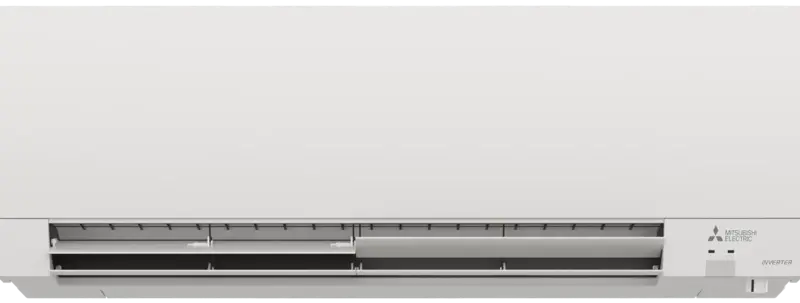
The MSZ-FS series represents the current single-zone flagship lineup. The 6,000 BTU MSZ-FS06NA achieves 32.2 SEER2 — the highest residential efficiency rating verified in any brand researched. Larger MSZ-FS BTU sizes step down in efficiency: the lineup runs 32.2 down to 21 SEER2 across the 6K, 9K, 12K, 15K, and 18K BTU configurations. The MSZ-FS series uses Hyper-Heat INVERTER (H2i) cold-climate technology.
Multi-Zone Systems
Multi-zone systems pair a single outdoor unit with multiple indoor units distributed across rooms. Mitsubishi multi-zone equipment serves whole-home applications without ductwork. Specific SEER2 and HSPF2 ratings vary by indoor-unit count and BTU mix — verify with the AHRI Reference Number for the exact configuration.
Ducted Indoor Units
Mitsubishi ducted indoor unit options include vertical air handlers that distribute conditioned air through limited ductwork. These applications fall between pure mini-split (no ductwork) and pure central AC (full ductwork). Mitsubishi ducted systems compete with Carrier crossover platforms in this niche.
April 2025 R-454B Series Launch
METUS launched the R-454B refrigerant series on April 17, 2025, completing Mitsubishi’s transition from legacy R-410A M-Series equipment. The new lines include FX (single-zone Hyper-Heat), GX (multi-zone), HX, WX, and SMART MULTI. All R-454B equipment satisfies the federal AIM Act manufacturing deadline of January 1, 2025.
| Mitsubishi Series | Equipment Type | Key Technology | Refrigerant |
|---|---|---|---|
| MSZ-FS | Single-zone mini-split | Hyper-Heat H2i | R-410A → R-454B transition |
| FX | Single-zone H2i (post-R-454B) | Hyper-Heat | R-454B |
| GX | Multi-zone | Standard | R-454B |
| HX, WX, SMART MULTI | Specialty configurations | Varies | R-454B |
| Ducted vertical air handlers | Ducted heat pump | Crossover | R-454B |
Video: Why is my electric Bill so High!!! Mitsubishi Mini Split Hyper Heat Review Part 4. Feb 2020 Bill · J-Mart
## Pricing by ConfigurationMitsubishi pricing positions in the premium tier of the US ductless market. METUS does not publish model-specific MSRP. Diamond Contractors and authorized Mitsubishi dealers set local installed pricing based on equipment selection, regional labor rates, and installation complexity.
| Configuration | Estimated Installed Range | Notes |
|---|---|---|
| Single-zone MSZ-FS 6K-12K BTU | $4,500–$7,500 | Smaller room conversions |
| Single-zone MSZ-FS 15K-18K BTU | $5,500–$9,000 | Larger rooms |
| Multi-zone 2-room | $8,000–$14,000 | Two indoor units + outdoor |
| Multi-zone 4-room | $14,000–$22,000 | Four indoor units + outdoor |
| Multi-zone 5+ room | $18,000–$30,000+ | Five+ indoor units |
Three pricing factors drive variance. Regional labor rates differ by 30–40% between California, Northeast, Pacific Northwest metros and Sunbelt markets. Diamond Contractor installations typically command 10–20% premium over standard Mitsubishi dealer installations because of certification requirements. Refrigerant line routing complexity adds material cost when distances exceed standard 50-foot runs.
You should request quotes from at least two Diamond Contractors and one standard authorized Mitsubishi dealer in your ZIP code. Itemize each quote: equipment, labor, refrigerant charge, electrical, permits, line set materials, and disposal broken out separately. Bundled all-in quotes typically hide significant pricing variance.
The 2025–2026 pricing has converged from the historical Mitsubishi premium. Daikin and Carrier mini-split equipment now competes at similar price points where they were once meaningfully cheaper. Compare quotes across brands rather than assuming Mitsubishi premium positioning.
Efficiency and Performance
Hyper-Heat H2i Technology
Hyper-Heating INVERTER (H2i) is Mitsubishi’s proprietary cold-climate technology that maintains heating output at low outdoor temperatures. The technology distinguishes Mitsubishi from competitors that typically lose heating capacity below 32°F without supplemental electric resistance heat.
Verified Operating Specifications
| H2i Spec | Mitsubishi US Residential | Notes |
|---|---|---|
| Rated minimum operating temperature | -13°F | US residential H2i rating |
| Heating capacity retention at 5°F | 100% | Verified spec |
| Indoor sound floor | 19 dB(A) | Industry-leading quiet |
Common Confusion: H2i Is Not Zubadan
The -13°F rating applies to US residential H2i technology. Mitsubishi also markets Zubadan cold-climate equipment for European and commercial applications that rates to -22°F. The two technologies share design heritage but apply to different product lines and markets. US residential buyers should expect H2i performance to the -13°F spec, not the -22°F Zubadan number sometimes incorrectly cited.
Real-World Performance Caveat
Marketing claims of -13°F operation describe the rated minimum operating temperature on the official spec sheet. Real-world performance depends on installation quality, building envelope, and refrigerant charge accuracy. The active class-action investigation discussed below alleges real-world capacity drops below 20°F in some installations — a meaningful gap between marketing claim and field experience that buyers in cold climates should understand before purchase.
SEER2 and HSPF2 Ratings
SEER2 (Seasonal Energy Efficiency Ratio, 2023 federal test methodology) replaced the legacy SEER scale in 2023. SEER2 ratings typically run 5% lower than identical hardware would score under the older SEER metric. HSPF2 (Heating Seasonal Performance Factor 2) measures heat pump heating efficiency under the same 2023 methodology revision.
| Mitsubishi Model | Configuration | SEER2 (Verified) |
|---|---|---|
| MSZ-FS06NA | Single-zone 6,000 BTU | 32.2 SEER2 |
| MSZ-FS09NA | Single-zone 9,000 BTU | Lower than 32.2 |
| MSZ-FS12NA | Single-zone 12,000 BTU | Lower |
| MSZ-FS18NA | Single-zone 18,000 BTU | 21 SEER2 (lineup bottom) |
| Multi-zone configurations | Varies by indoor count | Tier-dependent |
The 32.2 SEER2 figure on the 6,000 BTU MSZ-FS06NA represents the highest residential SEER2 verified across all major HVAC brands researched. The smaller BTU size achieves higher SEER2 because part-load efficiency improves at lower capacity demand. Larger BTU sizes in the MSZ-FS lineup step down toward 21 SEER2 at the 18,000 BTU configuration.
Buyers should pull the AHRI Reference Number for the exact outdoor-plus-indoor combination from the installing Diamond Contractor. AHRI publishes certified matched-system ratings that supersede peak model marketing claims. The AHRI number is the binding figure for tax credit, ENERGY STAR Most Efficient, and state rebate eligibility.
Warranty Terms and Registration
Mitsubishi warranty terms vary by installer certification. Standard authorized dealer installations carry the base 10-year parts plus 10-year compressor warranty. Diamond Contractor installations carry the extended 12-year parts plus 12-year compressor warranty. The two-year warranty extension is the most consequential benefit of selecting a Diamond Contractor for installation.
Standard 10/10 Warranty
Mitsubishi mini-split equipment installed by any authorized dealer receives 10 years parts coverage plus 10 years compressor coverage when registered within the standard window. This matches the federal minimum quality tier for residential HVAC parts coverage. Labor coverage is typically zero years standard — buyers needing labor protection negotiate separately with the installing dealer.
Diamond Contractor 12/12 Extended
The Diamond Contractor designation represents the elite tier of Mitsubishi authorized dealers. Diamond Contractors meet additional training, technical certification, customer satisfaction, and installation quality requirements. Diamond Contractor installations receive the extended 12-year parts plus 12-year compressor warranty — the longest Mitsubishi term available to US homeowners.
Why the Diamond Contractor Requirement Matters
The 12/12 warranty gating creates an installation-quality incentive structure. Mitsubishi rewards homeowners who select certified installers with longer manufacturer coverage. Standard dealer installations save dealer-side training costs but cap manufacturer warranty at 10/10. The buying logic: if you plan to use the equipment beyond 10 years, the Diamond Contractor premium often pays back through the extended warranty alone.
| Warranty Component | Standard Install | Diamond Contractor Install |
|---|---|---|
| Parts | 10 years | 12 years |
| Compressor | 10 years | 12 years |
| Labor (standard) | 0 years | 0 years |
| Heat exchanger (n/a for mini-split) | n/a | n/a |
Register your Mitsubishi system through your installing dealer at installation time. Diamond Contractor dealers handle the registration as part of the install process. Standard dealer installations may require homeowner-initiated registration — verify with your specific dealer.
Reliability and Known Issues
Active Class-Action Investigation (Critical Disclosure)
A material disclosure shapes any Mitsubishi mini-split purchase decision in 2026. Migliaccio & Rathod LLP opened an active class-action investigation against Mitsubishi in August 2025. The investigation focuses on Hyper-Heat equipment performance versus marketing claims.
Investigation Allegations
The Migliaccio & Rathod investigation alleges three issues. First, Hyper-Heat compressor failures at higher-than-expected rates in some installations. Second, control-board failures affecting equipment reliability. Third, real-world capacity drops below 20°F despite Mitsubishi marketing claims of “-13°F operating” capability. The capacity-drop allegation is the most consequential because it directly affects the cold-climate value proposition that drives many Mitsubishi purchases.
What the Investigation Means
A class-action investigation is the pre-litigation phase before formal class certification. Migliaccio & Rathod is collecting evidence and potentially affected homeowners. The investigation does not automatically translate into liability — Mitsubishi has not been found liable through the pre-litigation process. The existence of the investigation itself does signal accumulated complaints sufficient to warrant attorney attention.
Implications for Cold-Climate Buyers
Cold-climate buyers selecting Mitsubishi specifically for the -13°F Hyper-Heat rating should understand that real-world performance may not consistently match the marketing claim per the investigation. Recommended framing for purchase decisions:
- Treat the -13°F rating as the rated spec, not guaranteed field performance
- Require the Diamond Contractor to size for backup electric resistance heat below 20°F
- Document installation conditions, refrigerant charge accuracy, and commissioning data
- Consider competitor cold-climate options (such as Carrier Infinity 27VNA1 with cold-climate certification) for highest-stakes cold-climate applications
Investigation Status
The Migliaccio & Rathod investigation remains active as of May 2026. Affected homeowners experiencing Hyper-Heat compressor failures, control-board issues, or below-spec cold-climate performance should consult qualified legal counsel directly rather than rely on summary coverage.
R-454B Refrigerant and A2L Sensor Issues
Federal AIM Act rules required HVAC manufacturers to stop producing new R-410A units after January 1, 2025. R-410A units must be installed by January 1, 2026. Mitsubishi (via METUS) chose R-454B refrigerant as the R-410A replacement — joining the Carrier, Bryant, Lennox, Trane, Rheem, and York camp. Goodman, Amana, and Daikin chose R-32 through Daikin Comfort Technologies North America.
The 2026 cost reality on R-454B has been harsh for service. Aftermarket R-454B cylinders ran $700–$2,000 per 20-pound cylinder in early 2026, up from $345 in 2021. Honeywell added a 42% surcharge on R-454B earlier this year. R-32 refrigerant supply chain pricing has stayed more stable. A typical residential mini-split leak repair consumes 2–4 pounds of refrigerant. Service economics over the 15-year mini-split lifespan favor R-32 systems on refrigerant supply costs alone.
This creates a meaningful Daikin advantage versus Mitsubishi for buyers prioritizing service costs over cold-climate range. Mitsubishi wins on cold-climate capability and quiet operation; Daikin wins on R-32 refrigerant currency.
R-454B carries the A2L safety classification (mildly flammable). First-generation MOS leak sensors on A2L-refrigerant equipment cross-react with VOCs from spray foam insulation, paint, vinyl flooring, and even hairspray. The result is nuisance lockouts that look like refrigerant leaks but aren’t. This is not Mitsubishi-specific — it affects all A2L-refrigerant equipment industry-wide.
How Mitsubishi Compares to Alternatives
Mitsubishi vs Daikin
Mitsubishi and Daikin compete most directly in the US ductless mini-split market. Both Japanese manufacturers bring premium engineering reputation, but the brands differ on cold-climate range, sound floor, warranty structure, and refrigerant choice.
| Spec | Mitsubishi | Daikin |
|---|---|---|
| Flagship SEER2 | 32.2 (MSZ-FS06NA 6K BTU) | 21 (Aurora) |
| Hyper-Heat / Cold-climate range | -13°F (H2i) | ~-4°F (Aurora) |
| Indoor sound floor | 19 dB(A) | 23–26 dB(A) |
| Warranty (standard) | 10/10 | 12/12 |
| Warranty (extended path) | 12/12 via Diamond Contractor | Already 12/12 standard |
| Refrigerant | R-454B (METUS April 2025) | R-32 |
| US Distribution | METUS (Trane Tech JV) | Daikin Comfort Technologies NA |
| US Market Share (ductless) | #1 | Top 3 |
| Class-Action Investigation | Active (Aug 2025) | None comparable |
When Mitsubishi Wins
Cold-climate applications below 20°F favor Mitsubishi for the H2i operating range and 100% capacity retention at 5°F. Quiet-operation prioritizers benefit from the 19 dB(A) indoor sound floor that Daikin cannot match. Single-zone retrofits at small BTU sizes (6K-12K) benefit from the MSZ-FS series industry-leading SEER2.
When Daikin Wins
Long-stay owners prioritizing warranty length without installer constraints prefer Daikin’s 12/12 standard. Service-cost-conscious buyers prefer Daikin’s R-32 refrigerant versus Mitsubishi’s R-454B (more expensive to service in 2026). Hot and humid climate buyers (Florida, Gulf Coast, deep Southeast) value Daikin’s tropical-climate engineering more than Mitsubishi’s cold-climate focus.
Mitsubishi vs Carrier and Lennox Mini-Splits
Mini-split competition extends beyond Daikin to include Carrier and Lennox ductless lineups. The comparison below summarizes verified context.
| Brand | Flagship Mini-Split | SEER2 | Refrigerant | Cold-Climate Range |
|---|---|---|---|---|
| Mitsubishi | MSZ-FS06NA | 32.2 | R-454B (METUS Apr 2025) | -13°F H2i |
| Carrier | 38MPRB | 28.5 | R-454B (full transition) | Tier-dependent |
| Lennox | Various MS | Tier-dependent | mixed transition | Tier-dependent |
| Daikin | Aurora | 21 | R-32 | ~-4°F |
vs Carrier
Carrier’s 38MPRB Infinity mini-split reaches 28.5 SEER2 — outperforms Carrier’s central AC flagship at 21 SEER2 but trails Mitsubishi MSZ-FS06NA at 32.2. Carrier completed R-454B transition across all residential AC and mini-split models. Carrier warranty offers Consumer Choice 10-year parts or 5-year parts plus 3-year labor option with 90-day registration. Mitsubishi 10/10 standard or 12/12 via Diamond Contractor.
vs Lennox
Lennox publishes ductless mini-split options through partner distribution. Lennox SL25KCV at 26.0 SEER2 leads the residential central AC efficiency race but does not directly compete with mini-split-focused brands on ductless rankings. Buyers should verify specific Lennox mini-split SKU SEER2 ratings against Mitsubishi MSZ-FS lineup before comparison.
Rebates, Incentives, and Total Cost
The federal Section 25C Energy Efficient Home Improvement Credit terminated December 31, 2025, under the One Big Beautiful Bill Act. Installations completed by December 31, 2025, remain claimable on the 2025 tax return filed during the 2026 tax season. For 2026 installations, look to state HEAR (HEEHRA) rebates where your state has launched the program. Currently 15 states accept applications. Income tier qualification under Area Median Income rules determines rebate amount.
How to Buy: Dealer Network and Installation
Mitsubishi distributes through tiered dealer networks. Standard authorized Mitsubishi dealers operate broadly across the United States. Diamond Contractor dealers represent the certified elite tier with additional training and installation quality requirements. The Diamond Contractor designation gates the 12-year warranty extension discussed above.
Three Dealer Verification Steps
Three credentials matter when selecting a Mitsubishi dealer. State HVAC contractor licensing is required in approximately 35 states plus the District of Columbia — the remaining states require local licensing. EPA Section 608 certification is federally required for technicians handling refrigerants and does not expire once earned. Better Business Bureau ratings and Google review depth (50+ reviews spanning multiple years) provide independent verification beyond manufacturer dealer status.
Diamond Contractor Locator
The Diamond Contractor locator at mitsubishicomfort.com filters by ZIP code. Markets with multiple Diamond Contractors offer choice in pricing and service quality. Markets with sparse Diamond Contractor coverage may force buyers to choose between long travel distance (Diamond Contractor in next metro) and standard dealer installation (local availability, 10/10 warranty cap).
Installation Quality Drives Equipment Lifespan
Mini-split installations are particularly sensitive to installation quality because the refrigerant lines, condensate drain, and electrical connections must be field-fabricated rather than factory-assembled. Improper refrigerant charging, line set leaks, or condensate drain slopes can shorten equipment life significantly. The Diamond Contractor program addresses this concern through training and certification — making the 12/12 warranty gating practically aligned with installation reality.
Company Background and Ownership
Mitsubishi Electric Corporation was founded in 1921 in Tokyo, Japan. The company grew into a global electronics and electrical equipment manufacturer with US operations spanning consumer electronics, factory automation, semiconductors, and HVAC.
US distribution of Mitsubishi Electric residential HVAC equipment runs through METUS — Mitsubishi Electric Trane HVAC US LLC. The 50/50 joint venture between Mitsubishi Electric and Trane Technologies formed in May 2018, consolidating US residential ductless distribution into a single channel.
METUS distributes equipment under three brand badges: Mitsubishi Electric (standard channels), Trane Mitsubishi Electric (Trane dealer networks), and American Standard Mitsubishi Electric (American Standard dealer networks). The underlying equipment is identical across all three badges.
On the refrigerant transition: METUS launched R-454B equipment on April 17, 2025, placing Mitsubishi in the R-454B camp alongside Carrier, Bryant, Trane, and Rheem. Daikin, Goodman, and Amana use R-32.
Mitsubishi does not sell central AC equipment in the United States. The US product lineup consists exclusively of ductless mini-splits and ducted heat pump systems.