
Bryant HVAC Review 2026: Same Carrier Hardware, Lower Price
Founded 1904 by Charles W. Bryant. Acquired by Affiliated Gas Equipment 1955, now under Carrier Global. Evolution/Preferred/Legacy tiers mirror Carrier Infinity/Performance/Comfort with shared Indianapolis manufacturing.
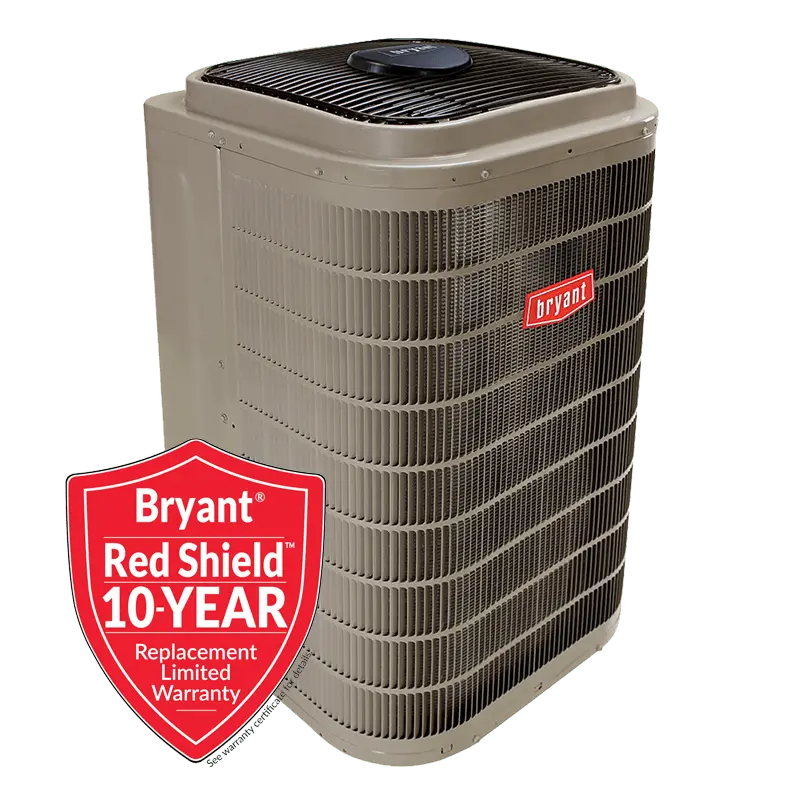
Brand facts
- Founded
- 1904
- Headquarters
- Indianapolis, Indiana, USA
- Parent company
- Carrier Global Corporation (NYSE: CARR)
- Website
- Official site
Pros
- Identical Carrier hardware at 10–15% lower installed price
- 90-day warranty registration window — longest in residential HVAC
- 10-year parts warranty (registered) across all three tiers
- Lifetime heat exchanger on Evolution `987M` when registered
- 1:1 SKU parity with Carrier — parts fully interchangeable
- Shared Indianapolis manufacturing — same components, same QC
Cons
- Consumer Choice 5-year parts + 3-year labor option not advertised on Bryant warranty page
- Broader general dealer network requires buyer to verify installer quality independently
- Carrier FAD tier-screening handles install-quality assurance that Bryant buyers must do themselves
- Copper-aluminum coils — no Spine Fin corrosion advantage vs Trane for coastal climates
- Mini-split `37MPRA` 35.1 SEER2 claim unverified — flagged open question
- R-454B refrigerant service costs $700–$2,000 per 20-lb cylinder in 2026
Bryant delivers identical Carrier hardware at 10–15% lower installed pricing through Carrier Global Corporation’s dual-brand strategy. The Evolution 191VAN flagship matches Carrier Infinity 26VNA1 at 21 SEER2. Both brands share the Indianapolis manufacturing plant. Bryant matches Carrier’s 90-day warranty registration window — the longest standard in residential HVAC. Bryant ranks highest among all HVAC brands for furnace error code troubleshoot intent.
Who Should Buy Bryant
Three buyer profiles benefit most from Bryant in 2026. Cost-conscious buyers who want Carrier-quality engineering save 10–15% on installed pricing through Bryant dealer distribution rather than Carrier Factory Authorized Dealers. Replacement buyers in markets with strong Bryant dealer coverage but thin Carrier FAD coverage get equivalent equipment without travel distance trade-offs. Long-stay homeowners who plan to register equipment within the 90-day window benefit from the same Consumer Choice-style 10-year parts coverage that Carrier offers.
Three scenarios where Bryant fits less well. Buyers seeking the Carrier Consumer Choice 5-year parts plus 3-year labor option find Bryant does not advertise this term on the official warranty page — it appears Carrier-channel specific. Premium-tier shoppers committed to the Carrier brand prestige for resale value perception often select Carrier despite the price differential. Coastal homeowners who value Trane’s Spine Fin coil corrosion advantage find both Carrier and Bryant use traditional copper-aluminum coils.
Specific Buyer Scenarios
A homeowner replacing a 15-year-old central AC in Atlanta who wants Carrier engineering at lower cost finds Bryant Preferred 148TAN at $3,500–$6,500 installed versus Carrier Performance 26TPA8 at $4,500–$7,300. Same hardware, same 18 SEER2 rating, same R-454B refrigerant. The buying logic favors Bryant when local dealer quality is comparable.
Product Lineup and Tiers
Bryant publishes a residential lineup organized into three tiers that mirror Carrier’s tier structure exactly. The naming convention uses Evolution for premium, Preferred for mid-tier, and Legacy for entry-level equipment.
| Bryant Tier | Equipment Coverage | Position |
|---|---|---|
| Evolution™ | Variable-speed AC, heat pump, modulating furnace | Premium flagship |
| Preferred™ | Two-stage AC, heat pump, two-stage furnace | Mid-tier |
| Legacy™ | Single-stage AC, heat pump, single-stage furnace | Entry |
| Crossover specialty | Identical model numbers to Carrier | Special applications |
Evolution Series (Premium)
Evolution central air conditioners include the 191VAN variable-speed flagship that matches Carrier Infinity at 21 SEER2 on R-454B refrigerant. The series uses the Evolution Connex communicating control architecture that pairs with variable-speed compressors and blowers for whole-home humidity management.
Evolution gas furnaces include the 987M modulating model with lifetime heat exchanger limited warranty when registered. The 987T and 986T two-stage models reach 96.7% AFUE. The 916S modulating-condensing furnace hits 97% AFUE for cold-climate buyers.
Preferred Series (Mid)
Preferred central air conditioners include the 148TAN two-stage model at 18 SEER2 — matching Carrier Performance 18 hardware. Two-stage operation delivers better humidity control and quieter operation than single-stage equipment at lower cost than variable-speed Evolution units.
Preferred gas furnaces include the 912S modulating-condensing model at 92.1% AFUE. The Preferred tier suits buyers seeking mid-efficiency equipment with two-stage operation across central AC, heat pump, and furnace categories.
Legacy Series (Entry)
Legacy central air conditioners include the 135SAN single-stage model at 16.5 SEER2 — matching Carrier Comfort 16. Legacy targets budget-conscious replacements and mild-climate installations where single-stage equipment delivers acceptable comfort at the lowest Bryant price point.
Most Legacy gas furnaces operate at 80% AFUE for cost-conscious buyers in mild climates where heating efficiency matters less. The Legacy tier offers the lowest installed pricing across the Bryant lineup.
Crossover and Specialty Equipment
Bryant and Carrier share identical model numbers for crossover and specialty equipment: 37MUHA (crossover heat pump), 37MURA (Compact crossover heat pump), and 33NM3 (domestic hot water air-to-water heat pump). The shared model numbers reflect identical hardware sold under both brand names through respective dealer networks.
Mini-Split Lineup (Open Question)
Bryant publishes the 37MPRA Evolution mini-split with a claimed 35.1 SEER2 and 30 HSPF2 on the official lineup page. This figure exceeds Carrier’s equivalent 38MPRB at 28.5 SEER2 — a discrepancy that suggests either a newer Bryant SKU or a stale page on one of the brand sites. The 35.1 SEER2 figure remains flagged for verification and should not be cited as confirmed until the product data sheet is independently checked.
Bryant vs Carrier Tier Mapping
Bryant and Carrier tier-map at 1:1 SKU pairs across the central AC, heat pump, and furnace lineups. The hardware specifications are functionally identical because both brands ship from the same Indianapolis manufacturing line.
| Bryant Model | Carrier Model | Both SEER2 | Compressor Stage |
|---|---|---|---|
Evolution 191VAN |
Infinity 26VNA1 |
21.0 | Variable-speed (Greenspeed) |
Preferred 148TAN |
Performance 26TPA8 |
18.0 | Two-stage |
Legacy 135SAN |
Comfort 26SCA5 |
16.5 | Single-stage |
Crossover 37MUHA |
37MUHA |
(identical) | Specialty |
Crossover 37MURA |
37MURA |
(identical) | Specialty |
Water heater 33NM3 |
33NM3 |
(identical) | Air-to-water |
If you receive a Bryant Evolution quote at one local dealer and a Carrier Infinity quote at another dealer, you are comparing identical hardware. The pricing differential typically reflects distribution channel cost differences rather than equipment quality differences. Bryant uses a broader dealer distribution network than Carrier’s Factory Authorized Dealer program.
The crossover equipment with identical model numbers makes the shared-manufacturing reality explicit. Carrier and Bryant publish the same SKUs on respective product pages for these categories because hardware is literally interchangeable.
Video: CARRIER/BRYANT HVAC Brand COMPARISON! · HVAC Guide for Homeowners
## Pricing — Equipment and InstalledBryant pricing typically runs 10–15% below Carrier for equivalent equipment because of distribution channel cost differences, not hardware differences. PICKHVAC pricing data confirms a 3-ton Bryant installation at $3,500–$6,500 versus Carrier’s $4,500–$7,300 for the same SEER2 rating.
| Tonnage | Bryant Installed Range | Carrier Installed Range | Bryant Savings |
|---|---|---|---|
| 2 ton | $3,000–$5,500 | $3,900–$5,900 | ~10–15% |
| 3 ton | $3,500–$6,500 | $4,500–$7,300 | ~10–15% |
| 4 ton | $4,500–$7,500 | $5,400–$8,400 | ~10–15% |
| 5 ton | $5,000–$8,500 | $5,900–$9,600 | ~10–15% |
What Drives the Pricing Differential
Three factors explain why Bryant installs cheaper than Carrier for identical hardware. Carrier Factory Authorized Dealers face stricter training, technical certification, and customer satisfaction requirements that add operational overhead. Carrier brand positioning targets premium-tier resale value perception that supports higher dealer pricing. Bryant distribution uses a broader general dealer network that competes on price rather than service certification.
You should request quotes from at least three authorized Bryant dealers in your ZIP code and at least one Carrier Factory Authorized Dealer for comparison. Itemize each quote: equipment, labor, refrigerant, electrical, permits, and disposal broken out separately. Bundled all-in quotes typically hide significant pricing variance.
Efficiency and Performance
SEER2 (Seasonal Energy Efficiency Ratio, 2023 federal test methodology) replaced the legacy SEER scale in 2023. SEER2 ratings typically run 5% lower than identical hardware would score under the older SEER metric. AFUE measures gas furnace efficiency as a percentage of fuel converted to delivered heat.
| Bryant Model | Equipment Type | Efficiency Rating | Refrigerant |
|---|---|---|---|
Evolution 191VAN |
Central AC | 21 SEER2 | R-454B (implied; verify on quote) |
Preferred 148TAN |
Central AC | 18 SEER2 | R-454B (implied) |
Legacy 135SAN |
Central AC | 16.5 SEER2 | R-454B (implied) |
Evolution 987M |
Modulating furnace | up to 98.5% AFUE | n/a |
Evolution 987T / 986T |
Two-stage furnace | 96.7% AFUE | n/a |
Evolution 916S |
Modulating furnace | 97% AFUE | n/a |
Preferred 912S |
Two-stage furnace | 92.1% AFUE | n/a |
For tax credit eligibility, ENERGY STAR Most Efficient certification, and state rebate programs, the SEER2 number is what counts. Always pull the AHRI Reference Number for the exact outdoor-plus-indoor coil pairing — AHRI publishes certified matched-system ratings that supersede peak model marketing claims.
Refrigerant Transition Status
Federal AIM Act rules required HVAC manufacturers to stop producing new R-410A units after January 1, 2025. R-410A units must be installed by January 1, 2026. Bryant chose R-454B refrigerant as the R-410A replacement — the same choice as parent Carrier and most major US brands. Goodman, Amana, and Daikin chose R-32 through Daikin Comfort Technologies North America.
Bryant lineup pages do not consistently state “R-454B” or “Puron Advance” explicitly on product cards — flagged as an open question for verification at quote time. The industry-wide 2025 transition and the shared Carrier manufacturing line (Carrier fully transitioned to R-454B) strongly imply Bryant equipment now ships R-454B. Buyers should verify the specific SKU refrigerant on the equipment data plate or written quote before signing.
R-454B Service Cost Reality
The 2026 cost reality on R-454B is harsh for service across all R-454B brands. Aftermarket R-454B cylinders ran $700–$2,000 per 20-pound cylinder in early 2026 (up from $345 in 2021). Honeywell added a 42% surcharge on R-454B earlier this year. A typical residential leak repair consumes 2–6 pounds of refrigerant, materially affecting service economics over the 15–20 year equipment lifespan.
A2L Sensor Calibration Issues
Both R-454B and R-32 carry the A2L safety classification (mildly flammable). First-generation MOS leak sensors on A2L-refrigerant equipment cross-react with VOCs from spray foam insulation, paint, vinyl flooring, and even hairspray. The result is nuisance lockouts that look like refrigerant leaks but aren’t. This is not Bryant-specific — it affects all A2L-refrigerant equipment industry-wide.
Warranty Terms and Registration
Bryant requires registration within 90 days of installation at bryant.com to receive the full extended warranty terms. This matches Carrier’s 90-day window — the longest registration deadline among major US residential HVAC manufacturers. Lennox, Goodman, Rheem, and Trane all require 60-day registration.
Registered Warranty Coverage
Bryant buyers who register within 90 days receive 10-year parts limited warranty across all three tiers. The Evolution 987M modulating gas furnace earns lifetime heat exchanger limited warranty for the original registered owner when registration completes on time.
Critical Difference vs Carrier
Bryant’s official warranty page does NOT advertise the “5-year parts plus 3-year labor” Consumer Choice option that Carrier offers. This appears Carrier-channel specific. Buyers wanting labor warranty coverage through Bryant should verify in writing with the installing dealer at quote time. Many Bryant dealers offer separate dealer-administered labor warranties at additional cost.
Default Unregistered Coverage
Without registration, Bryant warranty drops to 5-year parts only with no labor coverage and no extended heat exchanger term. This matches the federal minimum every major HVAC manufacturer provides.
| Warranty Component | Registered Term | Unregistered Term |
|---|---|---|
| Parts (all tiers) | 10 years | 5 years |
Heat exchanger (Evolution 987M) |
Lifetime | 20 years |
| Labor (standard) | 0 years | 0 years |
| Consumer Choice 5y+3y labor option | Not advertised | n/a |
Register your Bryant system at bryant.com within 90 days. The deadline starts the day the unit is energized, not the contract date. Keep the confirmation email permanently because warranty denials typically trace back to missed registration paperwork.
Reliability and Known Issues
Two recent CPSC recalls have affected Bryant equipment in cross-brand actions with Carrier and Daikin Comfort Technologies. Both reflect the shared-manufacturing reality of Bryant’s relationship with Carrier and the broader supply-chain interconnection across HVAC manufacturers.
2020 Carrier+Bryant Ductless Heat Pump Recall
The most significant Bryant recall hit in 2020 as a dual-brand action with Carrier. Affected equipment: ductless heat pump outdoor units sold March 2015 through April 2019.
| Recall Detail | Verified Figure |
|---|---|
| Units affected (US) | ~5,350 |
| Units affected (Canada) | ~450 |
| Models | 1.5 Ton multi-zone, 4 Ton multi-zone, 4 Ton single-zone ductless |
| Retail price range when sold | $600–$4,000 |
| Hazard | Fire risk |
| Fire incidents reported | 6 |
| Remedy | Free replacement |
The recall reflects shared manufacturing risk between Carrier and Bryant brands. Both brand ductless units originated from the same production line. The remedy through CPSC database lookup at cpsc.gov returns to the original purchaser via serial number verification.
2024 Cross-Brand DCT Packaged Units Recall
A separate 2024 recall affected approximately 12,100 packaged units across Daikin Comfort Technologies brands (Daikin, Amana, Goodman) plus Bryant via cross-manufacturing arrangements. The hazard was fire risk. Buyers of packaged units sold January through March 2024 should verify serial numbers against the recall database.
Furnace Error Codes and Troubleshooting
Bryant ranks highest among all HVAC brands for troubleshoot search intent in 2026 data. The brand has 17 unique autocomplete queries clustered around furnace error codes — significantly more than any competitor. The five most common Bryant furnace error codes appear repeatedly in technician forums and dealer service logs.
| Error Code | Common Cause | Typical Resolution |
|---|---|---|
| Code 13 | Limit switch lockout | Limit switch replacement; check airflow restriction |
| Code 14 | Ignition lockout | Hot surface igniter inspection; gas valve check |
| Code 31 | Pressure switch fault | Pressure switch test; check vent obstructions |
| Code 33 | Limit circuit fault | Limit circuit inspection; thermostat verification |
| Code 34 | Ignition proving failure | Flame sensor cleaning; igniter replacement |
Furnace error codes 13 and 14 indicate safety lockouts and require professional diagnosis. Do not attempt to clear lockouts repeatedly without identifying the root cause — the lockout protects the system and the home from gas-valve or ignition failures. EPA Section 608 certified technicians can safely diagnose ignition, gas-valve, and limit-circuit faults.
For non-emergency troubleshooting, you can find your Bryant model number on the data plate inside the blower compartment and look up the error code in the installation manual. Bryant publishes installation manuals at bryant.com under owner support resources.
How Bryant Compares to Top Alternatives
Bryant occupies a specific competitive position in the US residential HVAC market: Carrier-quality engineering at value-tier pricing through dealer distribution differences. The comparison below summarizes verified context across the major brands.
| Brand | Flagship SEER2 | Refrigerant | Registration | Tier Position |
|---|---|---|---|---|
| Bryant | 21 (Evolution 191VAN) | R-454B (implied) | 90 days | Value (Carrier hardware) |
| Carrier | 21 (26VNA1) | R-454B (full transition) | 90 days | Premium |
| Goodman | 22.5 (GSXV9) | R-32 (Daikin) | 60 days | Value |
| Lennox | 26 (SL25KCV) | mixed | 60 days | Premium efficiency leader |
| Trane | not published cleanly | mixed (XV20i still R-410A) | 60 days | Premium reliability leader |
vs Goodman
Bryant and Goodman compete on price, but the value proposition differs. Bryant offers Carrier engineering at 10–15% below Carrier pricing. Goodman offers Daikin engineering with R-32 refrigerant at 20–30% below Carrier pricing. Bryant’s 90-day registration window beats Goodman’s 60 days. Goodman’s GSXV9 at 22.5 SEER2 exceeds Bryant Evolution 191VAN at 21 SEER2. Goodman’s R-32 refrigerant currently delivers cheaper service costs than R-454B.
vs Lennox
Lennox SL25KCV at 26 SEER2 leads the residential SEER2 race. Bryant Evolution at 21 SEER2 trails by 5 efficiency points. Lennox uses proprietary parts engineering that limits service options outside the Lennox Premier Dealer network. Bryant parts share fully with Carrier through the Indianapolis manufacturing line. Bryant’s 90-day registration window beats Lennox’s 60 days.
vs Trane
Trane delivers stronger Consumer Reports reliability data (5/5 predicted vs Bryant’s shared Carrier 4/5) plus the patented Spine Fin coil for coastal corrosion resistance. Trane operates 60-day registration versus Bryant’s 90-day window. Trane pricing positions in the premium tier alongside Carrier — typically 10–15% above Bryant.
Rebates, Incentives, and Total Cost
The federal Section 25C Energy Efficient Home Improvement Credit terminated December 31, 2025, under the One Big Beautiful Bill Act. Installations completed by December 31, 2025, remain claimable on the 2025 tax return filed during the 2026 tax season. For 2026 Bryant installations, no federal tax credit is available.
State HEAR (HEEHRA) rebates are the primary incentive path for 2026 installations. Currently 15 states accept applications: NM, WI, NY, RI, MA, NC, GA, MI, MD, IN, IL, CO, WA, ME, and AZ. Income tier qualification under Area Median Income rules determines rebate amount — households at or below 80% AMI qualify for 100% rebates, 80–150% AMI qualify for 50% rebates, and households above 150% AMI are ineligible for HEAR. The heat pump rebate cap is $8,000 per household. Buyers in TX, FL, OH, VA, and MN should look to utility rebates — HEAR has not launched in those states. Use the AMI lookup at huduser.gov to determine your income tier before requesting quotes.
How to Buy: Dealer Network and Installation
Bryant distributes through a broader general dealer network without the tier-screening of Carrier’s Factory Authorized Dealer program. This delivers the pricing advantage but requires more buyer due diligence on dealer quality.
Three Dealer Verification Steps
Three credentials matter when selecting a Bryant dealer. State HVAC contractor licensing is required in approximately 35 states plus the District of Columbia — the remaining states require local licensing. EPA Section 608 certification is federally required for technicians handling refrigerants. The certification does not expire once earned. Better Business Bureau ratings and Google review depth (50+ reviews spanning multiple years) provide independent verification beyond manufacturer dealer status.
Installation Quality Drives Lifespan
Independent industry data shows installation quality drives 40–50% of equipment longevity. Buying Bryant hardware from an unverified contractor wastes most of the brand value. The Carrier FAD program addresses this through tier screening; Bryant requires buyers to do the verification themselves.
The Bryant dealer locator at bryant.com filters by ZIP code. Cross-check each dealer against state licensing databases (such as the California Contractors State License Board), the BBB business directory, and Google reviews before requesting a quote.
Company Background and Ownership
Bryant Heater Company was founded in 1904 by Charles W. Bryant. For the first half of the twentieth century, the company manufactured residential heating equipment as an independent manufacturer. In 1955, Carrier acquired Bryant through the Affiliated Gas Equipment merger — a transaction that also brought sister brands Day & Night and Payne into the Carrier portfolio. Bryant headquarters consolidated in Indianapolis at the existing Carrier manufacturing plant, where it has remained ever since.
Bryant operates today as a subsidiary brand of Carrier Global Corporation (NYSE: CARR). Carrier Global became a standalone public company in April 2020 when United Technologies spun off its climate business. Bryant equipment manufactures at the same Indianapolis plant as Carrier, on parallel assembly lines with identical components, engineering specifications, and quality control processes. The brand differentiation occurs at the distribution and dealer-network level, not at manufacturing. Bryant sits in the R-454B refrigerant camp alongside Carrier, Bryant, and Trane — as distinct from the R-32 camp of Daikin, Goodman, and Amana under Daikin Comfort Technologies North America.